

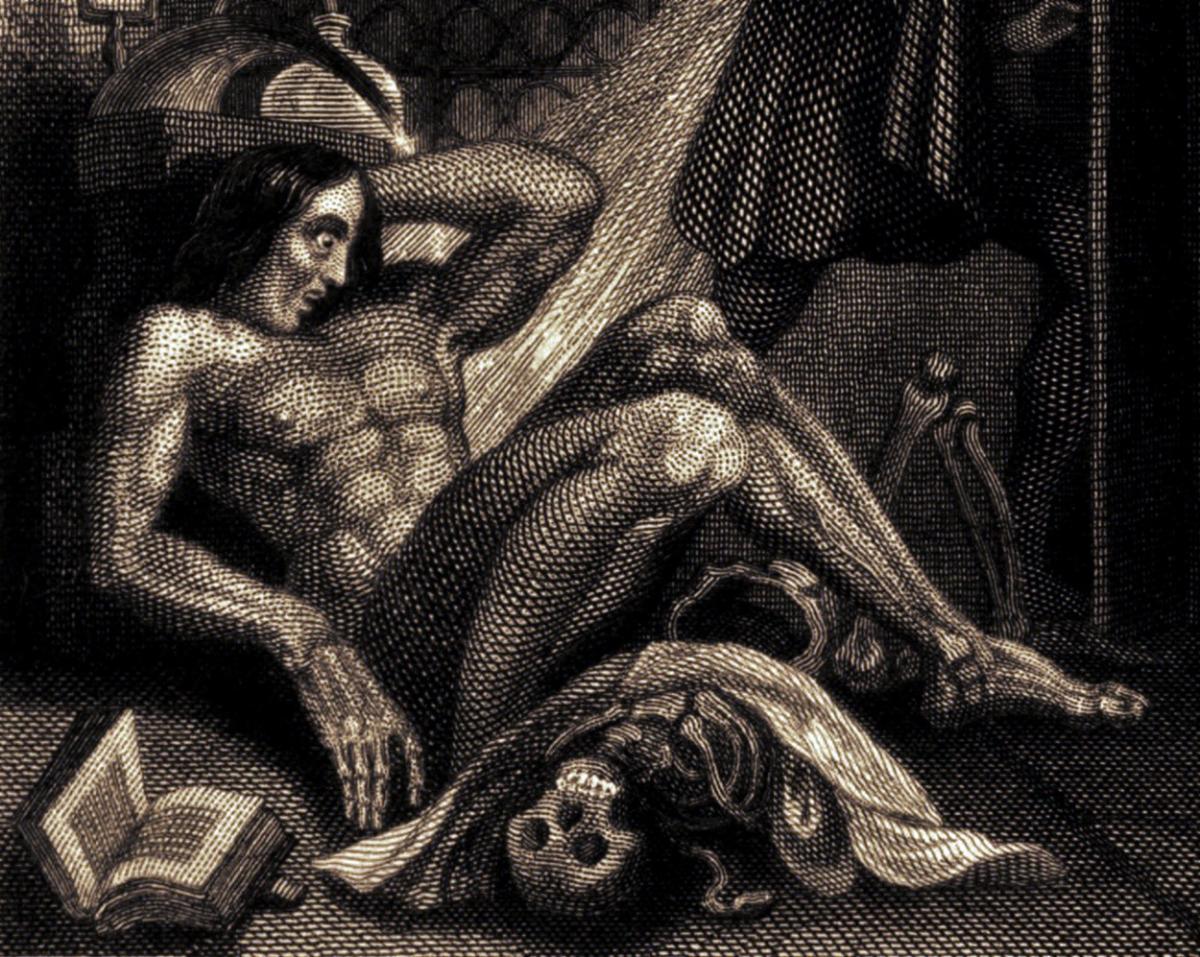
The experience of reading Mary Shelley’s Frankenstein a few weeks ago is still haunting me, and I need to talk about this.
First of all, the things we get wrong. You probably know that Frankenstein is the scientist — Victor Frankenstein — not the monster, right? Did you also know that the monster looks nothing like the square-headed, bolted-neck Hollywood creation made famous by Boris Karloff?
The image above — from a Steel engraving for the frontispiece of the book — shows the monster Shelley intended. As Victor Frankenstein explains:
“His limbs were in proportion, and I had selected his features as beautiful. Beautiful! Great God! His yellow skin scarcely covered the work of muscles and arteries beneath; his hair was of a lustrous black, and flowing; his teeth of a pearly whiteness; but these luxuriances only formed a more horrid contrast with his watery eyes, that seemed almost of the same colour as the dun-white sockets in which they were set, his shrivelled complexion and straight black lips.”
The monster actually starts his life as a curious, lonely, sensitive creature. He teaches himself to read and communicate so he can make friends. He loves nature and is fond of people. It’s only after being repeatedly outcast by humans that he becomes angry and violent. Call it Gothic road rage, perhaps?
But what was most surprising to me while reading Frankenstein was how time slowed down. Published in 1818, it’s written in a very formal style, with rich, thick prose. The story is told from several perspectives and through overlapping narratives. It’s woven with symbolism and vivid imagery, with an emphasis on the emotional and psychological experiences of the characters. Beautiful! Great God!
In short — reading Frankenstein requires you to slow down and pay attention. And I loved it! Not just the book — but the slower, disconnected pace of reading it.
I’ve been thinking a lot lately about the quiet space I allowed myself while reading Frankenstein. How I left my phone in the other room, stopped working at a reasonable time, kept Netflix out of the mix for more than a week. How my mind slowed down and my shoulders relaxed. How I relaxed.
There is something to be said about finding that kind of time, especially these days. Time off the grid, away from the busy-ness, and deeply connected to something other than our work and our technologies.
As summer fades into the slower seasons ahead, this is a good time to switch it up. Make some changes in your day to allow for a slower pace — read, write, rest, walk, wonder, create. Heck, you might even pick up a copy of Frankenstein to get you started!
HAPPY FALL!
— Jen Payne
EXTRA: Read “Places of Waiting,” a poem by Jen Payne


 Three Chairs Publishing
START A CONVERSATION. What do you think?